A post titled "And yet, it moves," published on the blog Signoregalilei and shared widely on Hacker News (134 points and 83 comments at last count), reacts to a claim that Anthropic has seemingly solved the Riemann Hypothesis. The author doesn't mainly ask whether the proof is right. The question is how it feels, and what it means for human discovery when a landmark result comes from a machine.
By the end of this piece, you'll have a way to think about that feeling, one that borrows from Galileo and doesn't depend on whether you're an AI optimist or skeptic.
A caveat first: I only have the blog's framing of events, not the underlying proof or any announcement from Anthropic. Treat the claim as the blog's description of a seeming solution, not as a settled, verified result.
What the post is actually arguing
Per the Signoregalilei post, the central argument is that an AI-generated breakthrough may be revolutionary yet still feel bittersweet, because it shifts discovery away from humans.
The author frames this through a Broadway musical about Galileo, using it as a lens on scientific discovery, truth, and human achievement. The title is the famous line attributed to Galileo after he was made to recant his claim that the Earth moves around the Sun: "And yet, it moves." The point of the line is that truth doesn't depend on who approves it.
That's the tension the post sits in. If truth is indifferent to who finds it, a proof is a proof whether a person or a model produced it. But humans don't only want truths. We want to be the ones who reach them.
Why Galileo is the right character for this
Galileo's story is usually told as a fight over authority: who gets to say what's true. Heliocentrism won because the evidence held, not because the powerful accepted it.
An AI result flips the old drama. Nobody is suppressing the truth. The worry is quieter: the truth arrives, and humans are spectators. In Galileo's era, the human stakes were about being allowed to discover. Now the stakes may be about whether discovery remains a human activity at all.
That's my reading of the parallel, not a claim from the post, but it explains why the Galileo frame works so well.
Why a math result feels different
The Riemann Hypothesis is among the most famous open problems in mathematics. Solving it would be a monumental achievement by any measure. That's exactly why the blog's reaction is interesting: the author treats it as potentially revolutionary and still finds it bittersweet.
Two things can be true at once:
- The result matters. A breakthrough of this size would change what mathematicians can build on.
- The meaning of the result changes with the discoverer. Human proofs carry a story of struggle, insight, and rivalry. A machine-produced one carries a different story, or arguably none.
This is the core emotional point. Science has always been a human narrative as well as a body of facts.
Why this question is landing now
AI has been moving from assisting knowledge work toward potentially producing landmark scientific and mathematical results. Helping a researcher draft code or check a calculation is one thing. Producing the headline discovery is another.
That shift raises cultural questions that are bigger than any single proof: does progress still feel meaningful when humans aren't the central discoverers? What happens to ambition, to genius, to the idea of a life spent on one hard problem?
The Hacker News thread's 83 comments suggest readers have plenty of opinions. I can't summarize them here, so I won't guess at which side dominates.
A practical way to hold both reactions
You don't have to pick between awe and unease. Here are three habits that help.
Separate the result from the credit
Ask two questions independently: Is it true? And who (or what) found it? The first is answered by verification. Galileo's line is a reminder that truth stands on evidence. The second is a cultural question, and it's fine for it to stay open.
Wait for verification before deciding how to feel
The post describes Anthropic as seemingly solving the problem. Big mathematical claims earn their status through scrutiny by other experts. Until that happens, hold the excitement and the grief loosely.
Notice what you value about discovery
If the idea of a machine proof bothers you, it's worth asking why. Is it the answer you care about, or the human effort behind it? Many people will find they care about both, and that tells you something about what science is for.
What happens to human curiosity
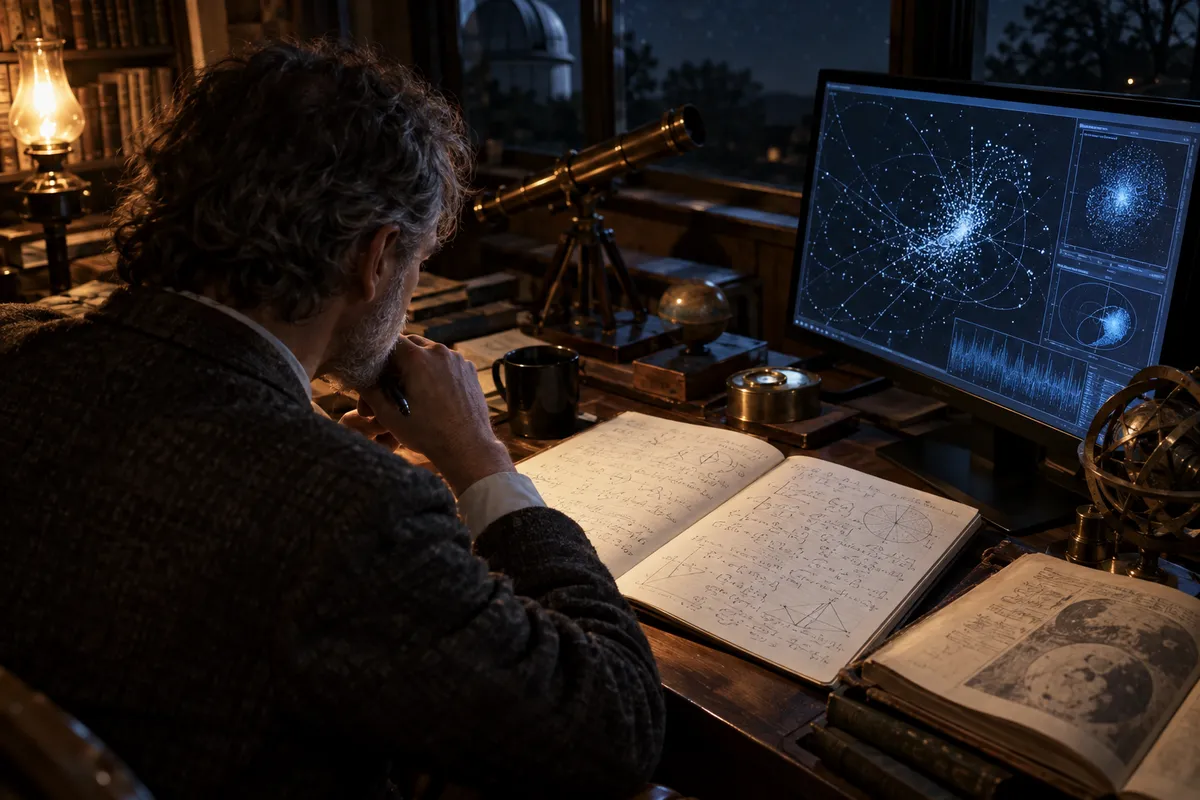
Galileo didn't just discover; he looked through a telescope and insisted others look too. A lot of science has been about that act of looking and sharing, not only about being first.
That suggests one hopeful reading: even if machines produce more of the breakthroughs, humans still have the job of understanding them, questioning them, and deciding what to do with them. Whether that feels like enough is exactly the question the blog leaves you with, and it's one worth answering for yourself.
So when the next big AI result lands, check the evidence first, then check your own reaction. Both are telling you something.