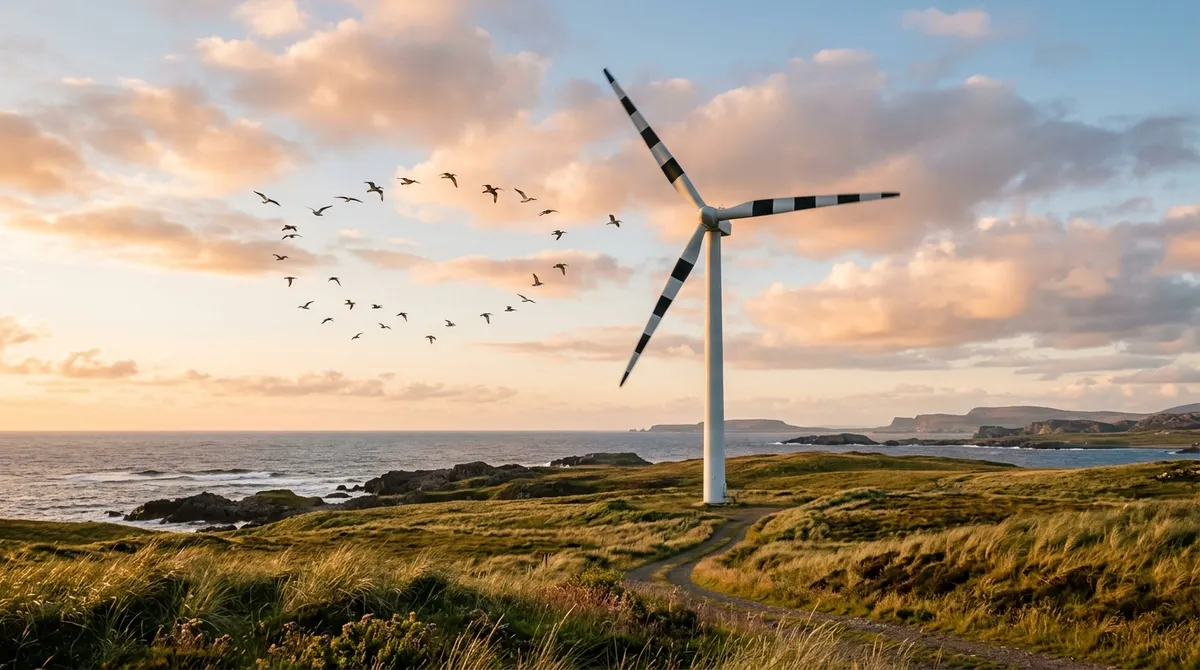
Wind turbines are central to the global push against climate change, but their spinning blades come with a hidden environmental cost — millions of bird deaths every year. Now, scientists are turning to bird neurobiology for a surprisingly elegant fix: stripes.
Researchers are developing turbine blade patterns specifically designed to exploit how birds perceive motion. According to reports, diagonal stripes and edge-focused designs could reduce bird collision deaths by as much as 70% — a figure that has generated significant excitement among both conservationists and renewable energy advocates.
How Birds See the World Differently
The science behind the stripes starts with understanding avian vision, which differs substantially from our own. Birds don't necessarily process fast-moving objects the same way humans do, and researchers have identified specific visual vulnerabilities that make spinning turbine blades effectively invisible — or at least unregistered as a threat — to approaching birds.
By designing blade markings that tap into these neurological quirks, scientists hope to make turbines far more visible and threatening-looking to birds in flight. One key concept driving the research is something researchers describe as a "barber-pole illusion" — a visual effect that exploits motion perception to grab avian attention in ways that plain white blades simply don't.
From Lab to the Field
The idea is promising, but the gap between laboratory results and real-world performance remains a significant challenge. According to reports, only three real-world field trials have been conducted so far, meaning the research is still in relatively early stages despite the compelling science behind it.
That cautious reality check matters. Lab conditions allow researchers to control for variables and measure bird responses precisely, but open environments introduce wind patterns, lighting changes, diverse species behaviors, and countless other factors that can alter outcomes. Scientists working in this area are careful to note that more field testing will be essential before striped blades become a standard industry solution.
Not One Size Fits All
Another layer of complexity is that different bird species respond differently to the visual patterns being tested. Research suggests that raptors and ptarmigans, for example, don't react in the same way to the same designs. This species-specific variation means a single universal stripe pattern may not be sufficient — solutions may need to be tailored to the bird populations most at risk in any given region where turbines are installed.
This adds some complexity to the rollout, but it also opens the door to smarter, more targeted conservation strategies. Wind farms situated along raptor migration routes, for instance, could be fitted with designs optimized for birds of prey, while installations in northern habitats might prioritize patterns effective for ground-nesting species.
A Low-Cost Fix for a Growing Problem
What makes this research particularly appealing is its scalability. Painting or manufacturing blades with stripe patterns is a relatively low-cost modification compared to other bird-deterrence technologies, such as radar-activated braking systems that slow turbines when birds are detected nearby. Crucially, blade markings don't interfere with energy generation, meaning clean power output wouldn't be sacrificed.
As wind energy expands globally — with thousands of new turbines expected to come online in the coming decades — even a modest reduction in per-turbine bird mortality could translate into millions of birds saved annually. A solution that is both affordable and effective at scale would represent a major win for the renewable energy sector's environmental credibility.
Biomimicry Meets Renewable Energy
This research fits into a broader and growing trend of biomimicry in clean energy technology — drawing inspiration from nature's own designs and biological systems to solve engineering and environmental problems. From whale-fin-inspired wind turbine blades to bee-vision-informed solar panel coatings, the natural world is increasingly being treated as a design manual for sustainable innovation.
The striped turbine project sits at a compelling intersection of neuroscience, conservation biology, and engineering. It asks a question that is both deeply practical and scientifically fascinating: if we understand how another species perceives the world, can we redesign our infrastructure to coexist more peacefully with it?
What Comes Next
For now, researchers are pushing for expanded field trials across a wider range of species, habitats, and turbine configurations. The early results are encouraging, but the scientific community is appropriately measured in its enthusiasm until larger datasets confirm what the laboratory work suggests.
If the field evidence holds up, striped wind turbines could become a standard feature of responsibly built wind farms worldwide — a small visual tweak with an outsized impact on one of renewable energy's most persistent ecological criticisms.