The Violent Genesis Paradox
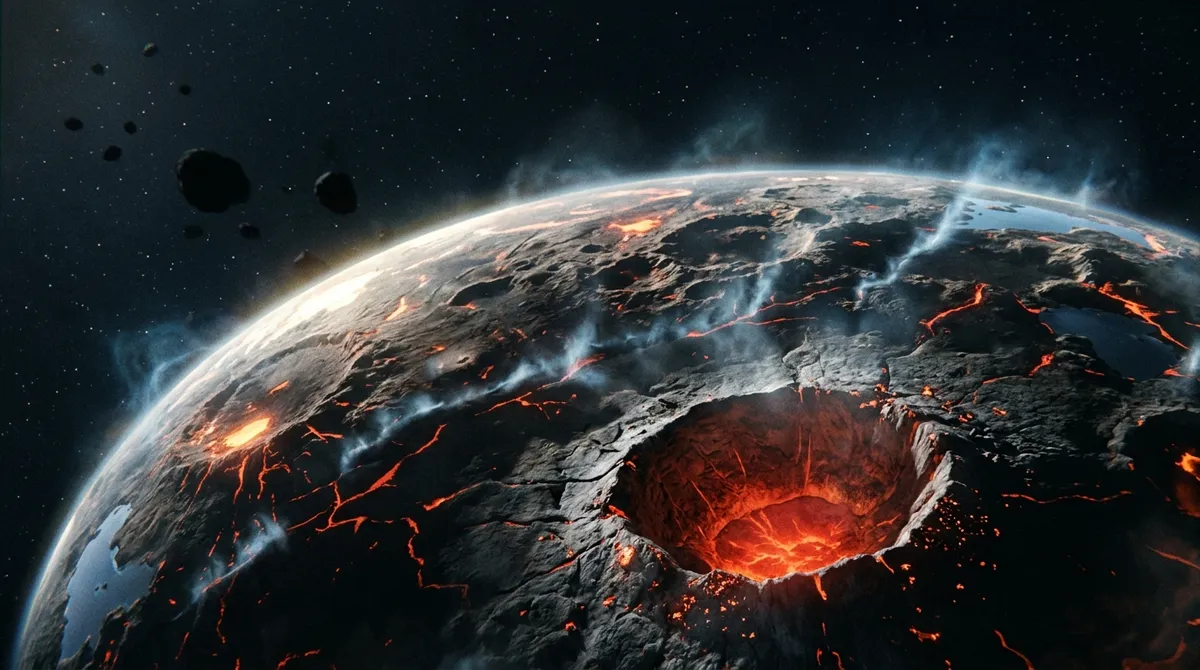
For Earth's first billion years, our planet endured relentless cosmic bombardment that would make any modern catastrophe seem tame. Yet new research suggests this seemingly destructive period between 4.6 and 3.5 billion years ago may have been precisely what life needed to get started.
According to recent impact simulations, the asteroid bombardment during the Hadean and Archean eons didn't just pummel Earth's surface—it fundamentally transformed the planet's crust in ways that enabled prebiotic chemistry to flourish.
Cracking Open the Path to Life
The research reveals that asteroid impacts during Earth's tumultuous early period fractured the crust and created highly permeable zones extending down to 8 kilometers below the surface. These impact-generated fractures allowed fluids and gases to circulate freely through rock, establishing the hydrothermal systems that likely provided the chemical conditions necessary for life to emerge.
This finding challenges the traditional "hellish early Earth" narrative that portrayed the bombardment period as purely destructive. Instead, the cosmic assault appears to have been a prerequisite for life, opening pathways through solid rock that would otherwise have remained impermeable.
Hydrothermal Systems as Life's Cradle
The impact-created hydrothermal systems described in the research share characteristics with modern environments known to support complex chemistry. Deep-sea vents and geothermal features like those in Yellowstone demonstrate how circulating fluids can drive the chemical reactions that might have preceded biology.
By fracturing the crust and enabling fluid circulation, asteroid impacts essentially turned early Earth into a planet-sized laboratory for prebiotic chemistry. The permeable zones allowed water, gases, and dissolved minerals to interact in ways that could have concentrated and organized the building blocks of life.
Reconstructing Ancient Conditions
Because few rocks on Earth are more than 4 billion years old, scientists rely on sophisticated modeling to understand conditions during this crucial period. The new research uses shock physics simulations to reconstruct how asteroid impacts would have affected the planet's structure during the Hadean and Archean eons.
These computer models suggest the bombardment created a network of fractured, permeable rock that extended far deeper than previously thought. The implications reach beyond Earth's surface, affecting the entire upper crust and creating conditions that persisted long after individual impacts.
Implications for Astrobiology
The research offers fresh insights relevant to the search for life beyond Earth. If asteroid bombardment was crucial for creating the conditions that enabled life on our planet, similar processes might be necessary on other worlds.
This framework could inform how scientists evaluate the habitability of exoplanets and moons that experienced heavy bombardment periods. Rather than viewing such cosmic violence as detrimental to life, researchers might need to consider whether adequate impact processing occurred to create the permeable crustal zones that prebiotic chemistry requires.
Rewriting Early Earth's Story
The findings contribute to an evolving understanding of Earth's earliest chapter. Rather than a simple progression from hostile to habitable conditions, the research suggests a more complex relationship between destruction and creation during our planet's formation.
The asteroid bombardment that defined Earth's first billion years may have been simultaneously the greatest threat to emerging life and its essential enabler. By fracturing the crust and establishing hydrothermal circulation systems, cosmic impacts created the very conditions that allowed chemistry to evolve toward biology.
This research reminds us that life's origins involved not just the right chemical ingredients, but also the right physical conditions to bring them together—conditions that required a violent cosmic beginning to achieve.