When Destruction Created Life's Pathway
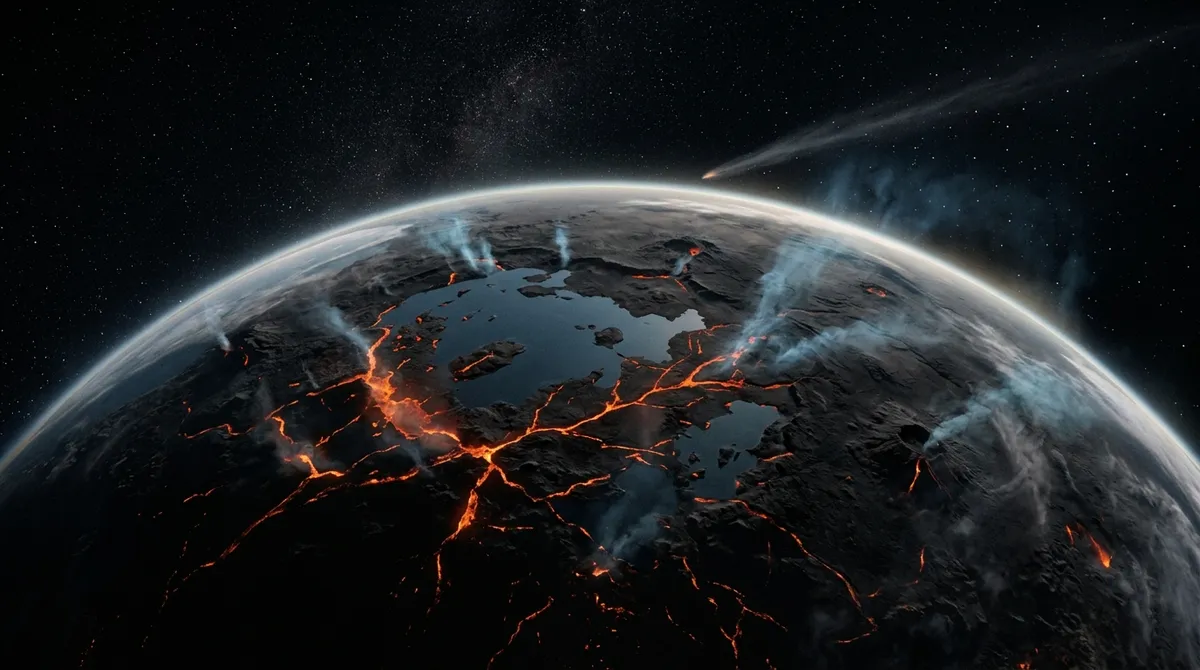
Earth's earliest era was anything but peaceful. For the first billion years of our planet's existence—from 4.6 to 3.5 billion years ago—asteroids and planetesimals relentlessly pummeled the surface during what scientists call the Hadean and Archean eons. While this cosmic bombardment has long been viewed as creating hellish conditions hostile to life, new research suggests the opposite may be true.
According to reports, impact simulations now reveal that this ancient bombardment actually fractured Earth's crust in ways that may have been essential for life's emergence. The asteroid impacts created highly permeable zones extending up to 8 kilometers deep into the crust, enabling crucial fluid and gas circulation through rock formations.
The Paradox of Violent Genesis
This research fundamentally challenges the traditional narrative of early Earth as an uninhabitable wasteland. Instead of viewing the bombardment as an obstacle to life's origin, scientists are now considering how these violent impacts may have been prerequisites for biological emergence.
The key lies in understanding how impact-generated fractures transformed the planet's geology. When asteroids struck the early Earth's surface, they didn't simply create craters—they fundamentally altered the crustal structure beneath impact sites. These fracture networks created pathways for water, gases, and dissolved chemicals to circulate deep within the rock, establishing complex hydrothermal systems.
Hydrothermal Systems as Life's Cradle
These ancient impact-generated hydrothermal systems likely provided the specific chemical conditions necessary for prebiotic chemistry—the molecular processes that preceded life. The circulation of fluids through fractured rock would have created environments where organic compounds could form, concentrate, and potentially organize into the first biological systems.
This concept connects to modern analogues that scientists study today, such as deep-sea hydrothermal vents and geothermal features like those found in Yellowstone. These contemporary systems support unique ecosystems and provide insights into how similar ancient environments might have fostered life's emergence.
Reconstructing Ancient Worlds
Understanding conditions on Earth 4 billion years ago presents unique challenges for researchers. According to reports, few rocks today are more than 4 billion years old, making direct geological evidence scarce. This is where simulation science becomes crucial.
Researchers use sophisticated shock physics models to reconstruct the planetary conditions that existed during the bombardment period. These simulations allow scientists to study how impact events would have affected crustal structure and fluid dynamics, providing insights into processes that occurred billions of years before any direct record exists.
Timeline of Earth's Violent Youth
The period in question spans Earth's most formative era. The Hadean eon, lasting from Earth's formation 4.6 billion years ago until about 4 billion years ago, was characterized by intense bombardment and extreme surface conditions. The subsequent Archean eon, extending to 3.5 billion years ago, saw continued but diminishing impact activity alongside the emergence of the first life forms.
During this billion-year span, the constant influx of asteroids and planetesimals gradually transformed Earth's surface and subsurface structure. Each major impact event would have created new fracture networks, potentially expanding the volume of rock available for hydrothermal circulation.
Implications for Finding Life Beyond Earth
This research has significant implications for astrobiology and the search for life on other planets. If impact-generated hydrothermal systems were crucial for life's emergence on Earth, similar processes might be important on other worlds.
Scientists searching for potentially habitable environments on exoplanets or icy moons in our solar system can now consider impact history as a factor in assessing habitability. Worlds that experienced similar bombardment patterns might possess the fractured crustal structures necessary to support prebiotic chemistry.
Rewriting Life's Origin Story
According to reports, this research offers fresh insights into where and how prebiotic chemistry could have occurred on early Earth. Rather than requiring special surface conditions or external delivery of organic compounds, life's emergence may have been enabled by the planet's own violent geological history.
The implications extend beyond understanding our own planet's history. As scientists continue studying potentially habitable worlds throughout the universe, this research suggests that cosmic violence—rather than cosmic calm—might be a prerequisite for life's emergence.