Exploration of Mars continues to captivate scientists and the public alike, with the latest images revealing enigmatic structures that resemble ancient Earth architecture. The Red Planet’s surface, captured by the HiRISE camera aboard the Mars Reconnaissance Orbiter, has offered intriguing visuals, sparking theories and curiosity about potential past civilizations or natural formations that mimic familiar structures.
Discovering Mars’ Intriguing Features
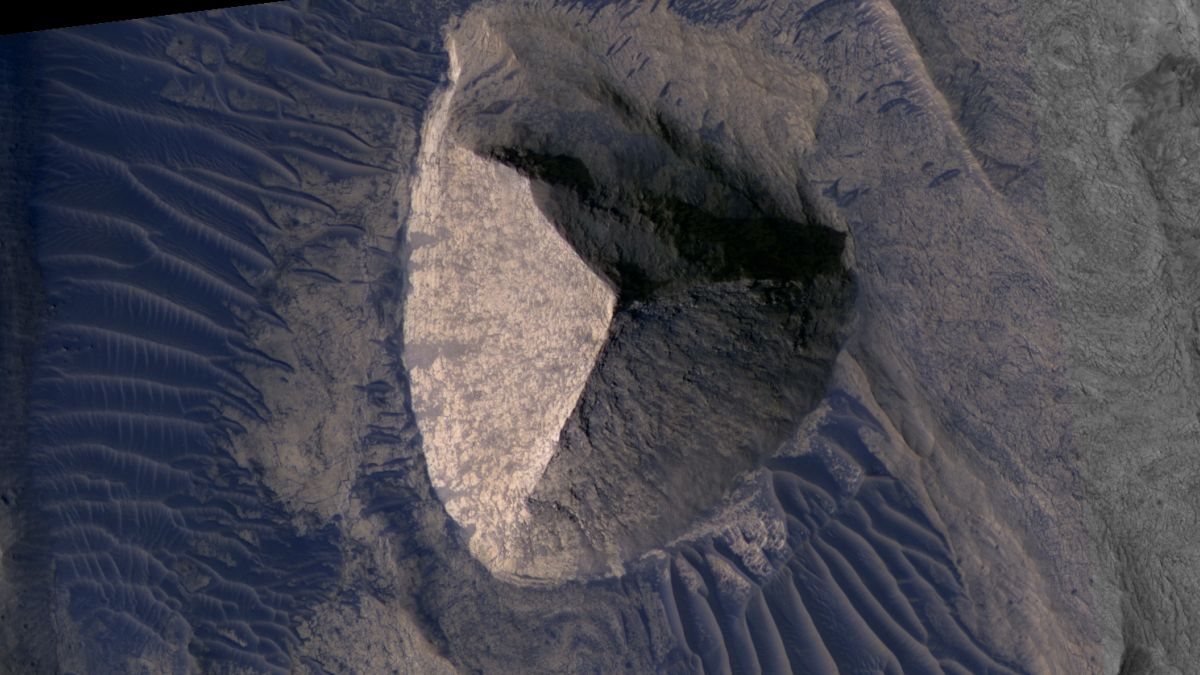
As the Mars Reconnaissance Orbiter surveys the Martian landscape, it frequently uncovers unusual formations that challenge our understanding of the planet’s history. Among these fascinating features is a structure that eerily resembles the pyramids of ancient Egypt. This discovery has led to a flurry of discussions among scientists and enthusiasts, speculating on its origins and significance.
The Role of the HiRISE Camera
The High-Resolution Imaging Science Experiment (HiRISE) camera plays a crucial role in Mars exploration, delivering detailed images of the planet’s surface. These images help identify geological features and potential sites of interest, such as the pyramid-like structure. The camera’s powerful capabilities allow scientists to analyze these formations with unprecedented clarity, offering insights into the planet’s geological past.
Natural Formation or Evidence of Past Life?
The pyramid-like structure, while striking, is likely a natural formation shaped by weathering and erosion over millions of years. Mars’ harsh environment, with its strong winds and dust storms, constantly alters the landscape. However, the resemblance to man-made structures fuels speculation about the possibility of ancient Martian life or civilizations, a topic of enduring fascination for both scientists and the public.
Scientific Investigations and Theories
Scientists are keenly interested in these formations as they provide clues about Mars’ geological processes. By studying these structures, researchers aim to understand more about the planet’s climate history and surface activity. Theories suggest that such formations may be remnants of a wetter, more dynamic Mars, where liquid water might have been present, altering the landscape significantly.
Comparisons with Earthly Structures
Comparisons between Martian and terrestrial structures often arise due to pareidolia, a psychological phenomenon where people see patterns, such as faces or familiar shapes, where none actually exist. This tendency leads to intriguing but speculative connections between Martian features and human-made structures on Earth. While these comparisons are fascinating, they often require a cautious approach, grounding interpretations in scientific evidence rather than imagination.
Implications for Future Mars Missions
The ongoing study of Mars’ surface features, including the pyramid-like structure, has significant implications for future exploration missions. Understanding the planet’s geology and history is essential for selecting landing sites for rovers and, eventually, human missions. These discoveries guide scientists in identifying areas that might harbor signs of past life or potential resources necessary for future colonization efforts.
Engaging the Public Imagination
Discoveries like the pyramid-like structure capture the public’s imagination, driving interest in space exploration and science. They remind us of the mysteries that remain within our solar system and the potential for future discoveries. Public engagement is crucial for maintaining support for space missions, ensuring continued exploration and investment in uncovering the secrets of Mars and beyond.
Conclusion
While the pyramid-like structure on Mars may not be evidence of ancient civilizations, it highlights the importance of continued exploration and study of the Red Planet. Each new discovery brings us closer to understanding Mars’ past and potential for future habitation. As technology advances and missions to Mars become more sophisticated, the mysteries of this neighboring planet will continue to unfold, offering endless opportunities for discovery and wonder.
#mars #spaceexploration #nasa #martianlandscape #discovery