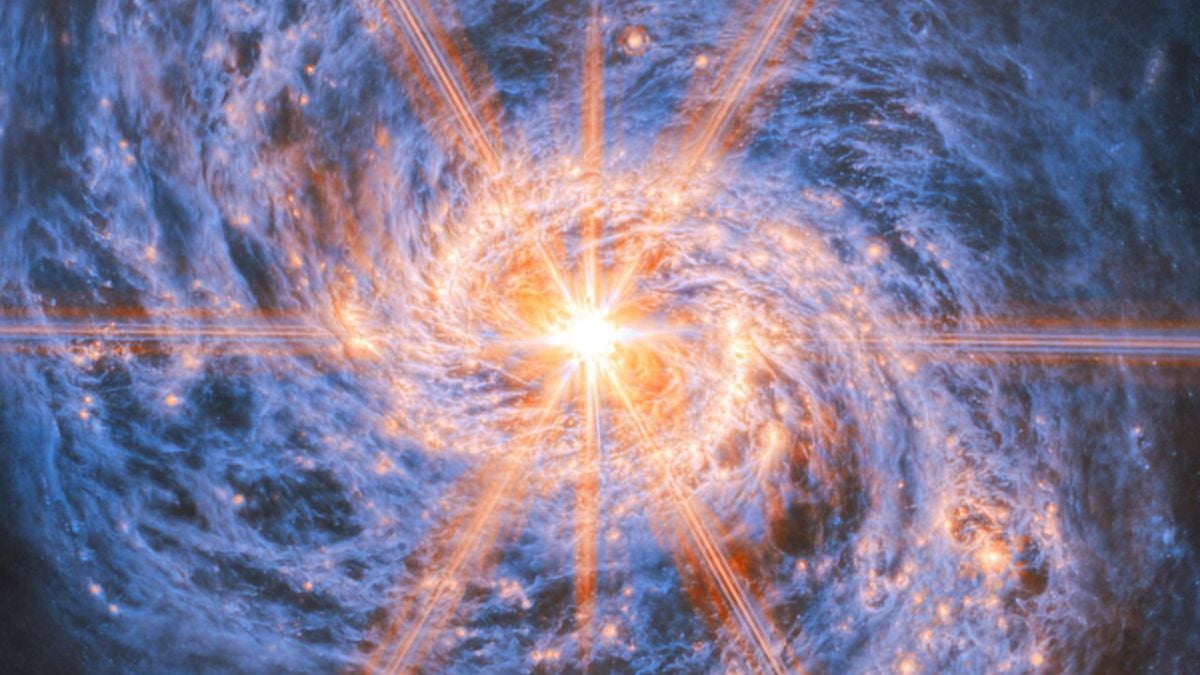
The James Webb Space Telescope has given astronomers a sharper look into NGC 6240, the dramatic galaxy merger often called the Squid Galaxy. Behind its thick dust and distorted arms, Webb has exposed a complex structure near the core, where gas, stars, and two supermassive black holes are reshaping an entire galaxy.
A turbulent galaxy with a memorable shape
NGC 6240 sits about 400 million light-years from Earth in the constellation Ophiuchus. It is not a calm spiral like the Milky Way. Instead, it is the wreckage of a major collision between large galaxies. Their gravitational encounter stretched stars and gas into long, uneven streams that resemble tentacles, giving the system its squid-like appearance.
This collision has turned NGC 6240 into one of the most fascinating nearby merger laboratories. It glows strongly in infrared light because dust absorbs intense radiation and releases that energy at longer wavelengths. That glow tells astronomers that the galaxy is packed with buried activity, including rapid star formation and energetic black hole growth.
For visible-light telescopes, the central region is difficult to study. Dust blocks much of the view. The most important action happens in places that older instruments could only partly resolve. Webb changes that by observing the universe in infrared wavelengths, where dust becomes less of a barrier.
Why JWST can see what other telescopes miss
The James Webb Space Telescope was built to study faint, distant, and dust-obscured cosmic targets. Its large mirror and infrared instruments make it especially powerful for examining galaxy mergers. In NGC 6240, Webb can separate overlapping structures that previously appeared blended together.
Infrared observations are essential in this galaxy because the central region is wrapped in gas and dust. Webb can detect warm molecular hydrogen, ionized gas, young star-forming regions, and heated dust. Each carries different information about what is happening inside the collision.
Rather than providing only a pretty image, Webb also allows astronomers to analyze light by wavelength. This reveals chemical fingerprints, temperatures, and motion. That means researchers can map not just where material lies, but how it moves and what powers its glow.
The hidden structure at the galaxy’s heart
Webb’s view shows that the core of the Squid Galaxy is not a simple bright center. It contains an intricate arrangement of filaments, knots, arcs, and cavities. These features trace gas that has been compressed, shocked, heated, and pulled into strange shapes by the ongoing merger.
The newly revealed structure appears across the central few thousand light-years. It is tied to the violent relationship between gravity and feedback. Some gas is likely moving inward, where it can feed star formation or black hole growth. Other gas is being driven outward by winds, radiation, and shock waves.
Warm molecular hydrogen is especially important here. Hydrogen molecules can shine in infrared light when they are heated by shocks. In a collision as intense as NGC 6240, huge gas clouds crash into one another. These impacts can generate powerful shock fronts that light up hidden material.
The result is a cosmic web inside the merger. Webb reveals a system full of channels and boundaries, rather than a smooth cloud. That level of detail helps scientists reconstruct the forces shaping the galaxy from the inside out.
Two supermassive black holes drive the drama
At the center of NGC 6240 are two supermassive black holes. They belong to the original galaxies that are now merging. The pair is separated by only a few thousand light-years, which is close on galactic scales. Over time, they are expected to move closer together.
Both black holes are embedded in a chaotic environment. Gas funnels toward the center as the merger removes angular momentum from orbiting material. Some of that gas may feed the black holes, causing them to shine as active galactic nuclei. Other material may form new stars in dense pockets.
Black holes do not only consume matter. When they accrete gas, they can release powerful radiation and launch outflows. These outflows can push on surrounding clouds, heat gas, and alter future star formation. In NGC 6240, Webb’s observations help trace this feedback in unusually fine detail.
The black hole pair also matters for gravitational wave astronomy. When supermassive black holes eventually merge, they should send ripples through spacetime. NGC 6240 offers a nearby example of a system moving toward that distant outcome.
What gas motion reveals about a galaxy merger
Galaxy mergers are deeply three-dimensional events. Stars, dust, gas, and dark matter all respond differently. Stars often pass by one another with little direct collision, while gas clouds collide, compress, and lose energy. That makes gas one of the best tracers of the merger’s violence.
Within the Squid Galaxy, Webb can identify regions where gas has been shocked or ionized. It can also show whether material is streaming inward or being expelled. These measurements are crucial because they reveal how galaxies transform during major collisions.
In some regions, gas compression may encourage star birth. In others, energetic feedback may heat or disperse the raw material needed to make stars. This tug-of-war controls how quickly the merged galaxy changes from an active, dusty system into a more settled object.
NGC 6240 may be showing astronomers a short-lived phase in that process. Its central structure is messy, bright, and dynamic. It captures a moment when the merger is still rearranging the galaxy’s fuel supply and central engines.
Why NGC 6240 matters for galaxy evolution
The Squid Galaxy is close enough for detailed study, yet extreme enough to resemble more distant galaxies from the earlier universe. Many ancient galaxies grew through mergers. They formed stars rapidly, fed central black holes, and produced huge amounts of infrared light.
By studying NGC 6240, astronomers can test ideas about how these processes work. The galaxy shows how collisions can funnel gas to galactic centers. It also shows how black holes and starbursts can return energy to their surroundings.
This balance is central to galaxy evolution. If gas keeps flowing inward, black holes and star formation can intensify. If feedback becomes strong enough, it may slow or shut down star formation. Webb’s detailed view helps reveal where that balance stands inside a real merger.
The findings also connect to the future of our own cosmic neighborhood. The Milky Way and Andromeda will merge billions of years from now. Their encounter will unfold differently, but systems like NGC 6240 help scientists understand the physics involved.
A new era for infrared astronomy
Webb’s observations of NGC 6240 show why infrared astronomy is transforming the study of dusty galaxies. Features once hidden behind thick material can now be mapped with remarkable clarity. Astronomers can examine the relationship between tiny central structures and galaxy-wide evolution.
Future observations may refine the picture further. Researchers can compare Webb data with radio, X-ray, and millimeter observations. Each wavelength reveals a different layer, from cold gas reservoirs to high-energy black hole activity.
Together, those data will help build a more complete model of the Squid Galaxy. They may show which gas streams are feeding the black holes, which regions are forming stars, and which outflows are clearing material away.
Conclusion
The hidden structure revealed by JWST in NGC 6240 is more than a striking cosmic detail. It is evidence of a galaxy being transformed by collision, star formation, shock waves, and two growing supermassive black holes. The Squid Galaxy now stands as one of the clearest nearby examples of how mergers reshape galaxies from their centers outward.
#jwst #squidgalaxy #blackholes #galaxymerger #space