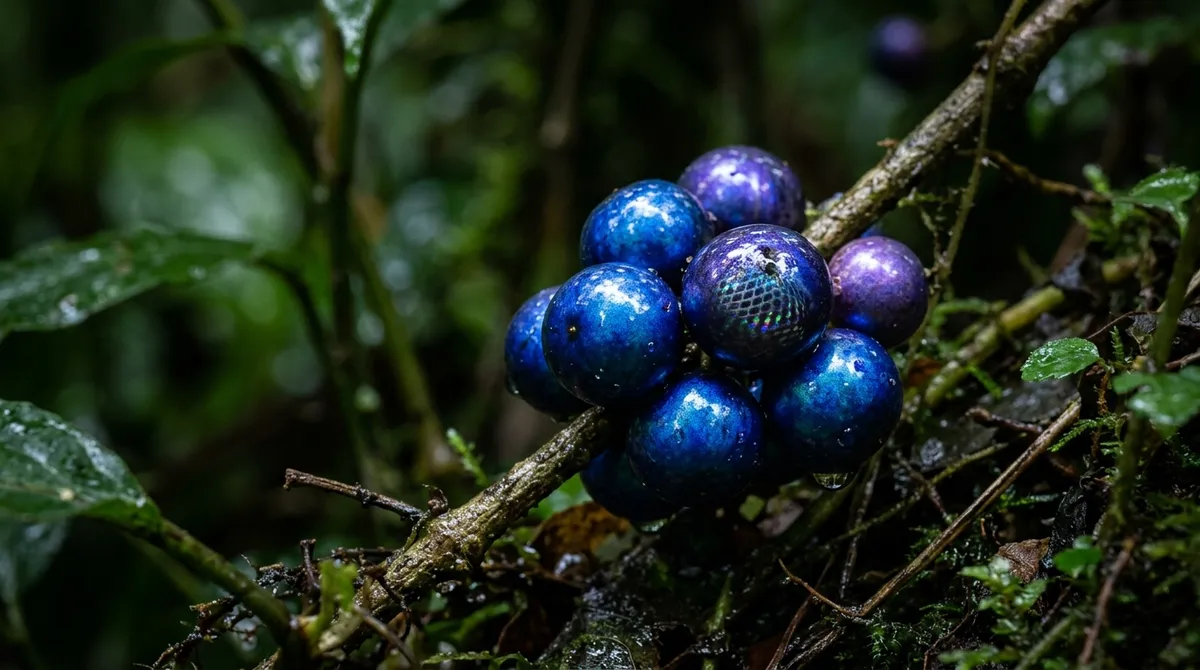
Nature continuously astonishes us with its extraordinary phenomena, and among these wonders is a vibrant fruit that appears to defy color expectations. The Pollia condensata, also known as the African marble berry, showcases a striking blue appearance. However, this fruit's vivid hue is not due to pigments but is a result of a remarkable optical illusion created by its unique structural properties.
The Marvel of Structural Coloration
Unlike most fruits that derive their colors from pigments, the Pollia condensata employs structural coloration. This phenomenon occurs when microscopic structures on the surface of an object interact with light in a way that creates color. The fruit's outer layer is composed of a complex arrangement of cellulose layers, each precisely spaced to reflect light at specific wavelengths, predominantly in the blue spectrum. This intricate layering results in the fruit's metallic blue sheen, captivating the eyes of both humans and animals.
How Structural Coloration Works
Structural coloration is a fascinating optical phenomenon. It relies on the interference of light waves, which are manipulated by microscopic structures. In the case of the Pollia fruit, the cellulose fibers are arranged in a helical pattern. When light strikes the surface, these fibers reflect and scatter light in such a way that only certain wavelengths are visible. This selective reflection is what gives the fruit its vibrant blue color, despite having no blue pigments.
Biological Significance of the Blue Illusion
One might wonder why a fruit would evolve to display such a bright color without pigmentation. The answer lies in its ecological interactions. The blue color serves to attract birds and other animals, which are drawn to the iridescent appearance. These creatures play a crucial role in seed dispersal, helping the plant to propagate its species across various regions. The dazzling appearance ensures that the fruit stands out against the green foliage, making it more likely to be noticed and consumed.
Pollia Condensata: A Botanical Wonder
This fruit is native to certain African forests and is a testament to the innovative ways plants adapt to their environment. The Pollia condensata thrives in understory habitats, where light conditions can vary. The bright blue color not only attracts seed dispersers but also aids in its identification by researchers studying plant-animal interactions. Moreover, the fruit's durable color does not fade over time, making it a subject of interest for biomimicry in technology and design.
Implications for Science and Technology
Beyond its biological marvel, the Pollia fruit's structural coloration has significant implications in various scientific fields. Researchers are keenly interested in understanding and replicating these natural structures for use in materials science and engineering. The potential applications include creating colorfast dyes and paints that do not rely on chemical pigments, reducing environmental impacts. Additionally, this technology could lead to advances in optical devices and security features, leveraging the principles of light interference and reflection.
Conclusion: Nature's Palette of Innovation
The Pollia condensata's stunning blue appearance is a testament to nature's ingenuity. Through the intricate dance of light and structure, this fruit captivates and informs. As scientists continue to explore the secrets behind its coloration, they uncover insights that could revolutionize technology and design. This small but mighty fruit reminds us of the endless possibilities that nature holds, inspiring innovation that draws from the wisdom of the natural world.