Sea turtles are supposed to be the long-haul travelers of the ocean world — guided by magnetic fields, ocean currents, and the sun, crossing entire ocean basins to feed and breed. That reputation made a recent finding from the Galápagos Islands genuinely startling: a population of yellow-morph green sea turtles tracked by scientists simply... stayed put. By the end of this piece, you'll understand what that means for the turtles, for the Galápagos Marine Reserve, and for the broader logic of how we protect marine species.
These Aren't Your Typical Green Sea Turtles
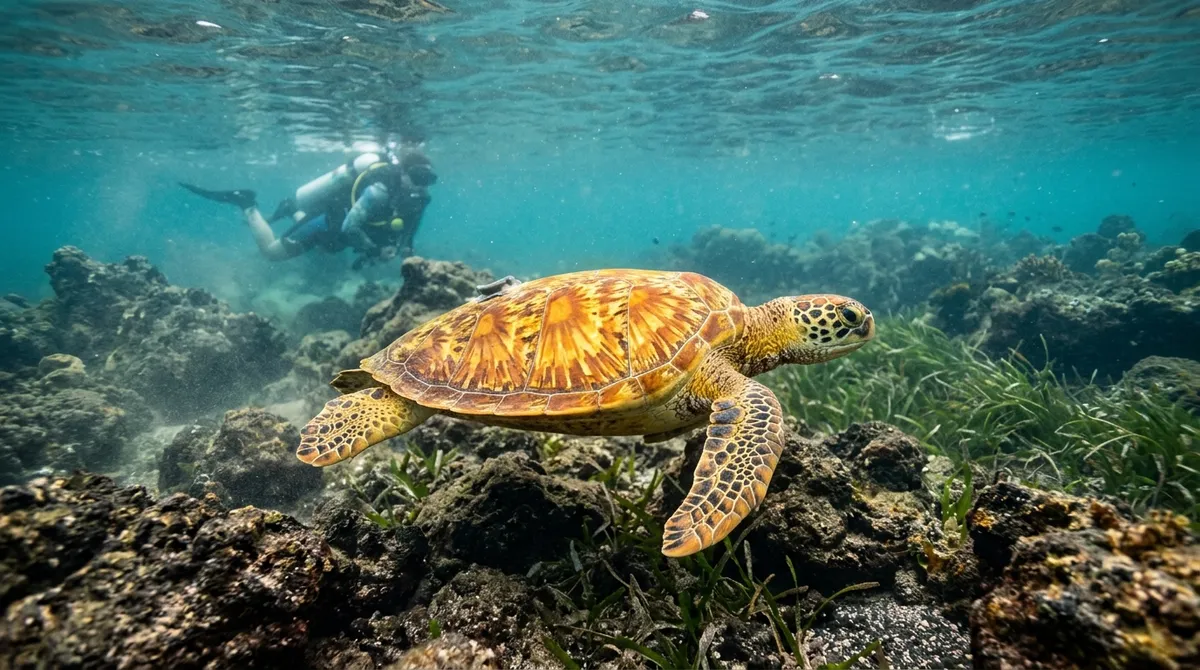
Most green sea turtles in the Galápagos are the familiar dark-shelled black morph. The yellow-morph turtles — named for their distinctly pale, yellowish coloring — are a rarer variant found in the archipelago. Scientists had broadly assumed that sea turtles, across morphs and populations, shared the same instinct to roam: feed in one region, migrate hundreds or thousands of kilometers to nesting beaches, repeat.
That assumption was worth testing with actual tracking data. Researchers fitted yellow-morph turtles with satellite tags and followed their movements over time. What the tags revealed upended the expected script.
The Turtles That Stayed
Rather than heading out into open ocean, the yellow-morph turtles in the study remained within the Galápagos Marine Reserve. They used shallow coastal habitats and moved between islands along inter-island routes — essentially staying local in an environment where "local" still means navigating one of the most biodiverse marine regions on Earth.
The finding surprised the research team precisely because sea turtles' epic migration reputation is so well established. These turtles weren't doing anything obviously wrong from a biological standpoint — they were feeding, using habitat effectively — they just weren't leaving. The marine reserve, it turns out, may be providing everything this particular population needs without forcing them to venture further afield.
The study, reported by Phys, suggests the yellow-morph turtles' reliance on shallow coastal habitats and local island routes is a genuine behavioral pattern, not a quirk of individual animals.
What Satellite Tags Actually Reveal
It's worth pausing on how scientists know any of this. Satellite tracking has transformed what researchers can learn about marine animals without ever seeing them directly. A tag attached to a turtle's shell transmits its location whenever the animal surfaces, building a detailed map of movement over weeks or months.
For sea turtles specifically, this technology has revealed everything from previously unknown feeding grounds to the precision with which individuals return to the exact beach where they hatched decades earlier. In this case, the same technology that confirmed other turtles' extraordinary migrations revealed that these yellow-morph animals were doing something fundamentally different — staying close, following coastal contours, crossing between islands rather than crossing ocean basins.
The contrast matters because it shows that population-level assumptions can be wrong in consequential ways. If you're designing a conservation strategy around the idea that your target species migrates far and returns periodically, a population that actually lives year-round within a specific reserve changes your entire approach.
Why This Complicates Sea Turtle Conservation
The traditional conservation framing for sea turtles involves protecting nesting beaches and then trusting that the open ocean provides adequate feeding habitat during their long migrations. International cooperation matters because the same turtle might feed in the waters of one country, nest on the beaches of another, and pass through a third's exclusive economic zone.
But if a population like the yellow-morph Galápagos turtles depends heavily on specific local habitats within a single marine reserve, the calculus shifts. The quality and integrity of that reserve becomes even more critical. Threats that might seem manageable for a wide-ranging migratory species — fishing pressure near the reserve boundary, coastal habitat degradation, tourism disturbance in shallow areas, climate-driven changes to local ecosystems — become acute risks for a population that has nowhere else to reliably go.
The Galápagos Marine Reserve is one of the largest protected marine areas in the world, but it isn't immune to these pressures. Illegal fishing, climate shifts affecting prey availability, and coastal development on inhabited islands all represent ongoing stressors. Knowing that yellow-morph turtles may be far more dependent on this specific habitat than previously understood raises the conservation stakes considerably.
What "Local" Really Means in the Galápagos
It's easy to underestimate what staying within the Galápagos Marine Reserve actually involves. The archipelago spans roughly 45,000 square kilometers of ocean, with islands separated by significant stretches of open water and wildly varying conditions between them. The inter-island routes these turtles apparently use, and the shallow coastal habitats they favor, are ecologically distinct environments with their own vulnerabilities.
The finding also raises questions worth pursuing in follow-up research: Do all yellow-morph turtles behave this way, or is there variation within the population? Is this pattern driven by the exceptional food availability within the reserve, by something specific to the yellow morph's biology, or by learned behavior passed through generations? Does the same local-habitat reliance hold for nesting, or do these turtles eventually migrate to breed?
The current study doesn't answer all of those questions, but it establishes the behavioral baseline that makes asking them worthwhile.
The Bigger Lesson About "Migratory" Species
The Galápagos yellow-morph result points to something conservation biologists have increasingly recognized: the label "migratory species" can obscure enormous variation in actual movement patterns. A species might be highly migratory on average while specific populations adopt far more sedentary strategies depending on local conditions, resource availability, and evolutionary history.
That variation means conservation plans built on species-wide generalizations can leave particular populations under-protected. The turtles that travel farthest may be visible and well-studied; the homebodies, staying within a single reserve, might be quietly more vulnerable because their entire world fits inside one political boundary — one that faces real and ongoing pressure.
The yellow-morph turtles of the Galápagos didn't read the field guide about where sea turtles are supposed to go. The smarter move, for scientists and policymakers alike, is to take that seriously rather than treating it as an anomaly to explain away.